<?xml version="1.0" encoding="utf-8"?><feed xmlns="http://www.w3.org/2005/Atom" ><generator uri="https://jekyllrb.com/" version="3.10.0">Jekyll</generator><link href="https://akh.cx/feed.xml" rel="self" type="application/atom+xml" /><link href="https://akh.cx/" rel="alternate" type="text/html" /><updated>2026-11-06T14:59:33+00:00</updated><id>https://akh.cx/feed.xml</id><title type="html">Aliaksei Khavanski</title><author><name>Aliaksei Khavanski</name></author><entry xml:lang="en"><title type="html">How easy is it to build an app now?</title><link href="https://akh.cx/2026-11-04-how-easy-is-it-to-build-an-app-now.html" rel="alternate" type="text/html" title="How easy is it to build an app now?" /><published>2026-11-04T00:00:00+00:00</published><updated>2026-11-04T00:00:00+00:00</updated><id>https://akh.cx/how-easy-is-it-to-build-an-app-now</id><content type="html" xml:base="https://akh.cx/2026-11-04-how-easy-is-it-to-build-an-app-now.html"><![CDATA[<p>I am not a developer by any means. As a PM, I don’t even write SQL queries: Claude does it for me. The last time I wrote a script was about 3 years ago. I wanted an easy way to manage mic settings from the macOS menu bar (and I succeeded).</p>

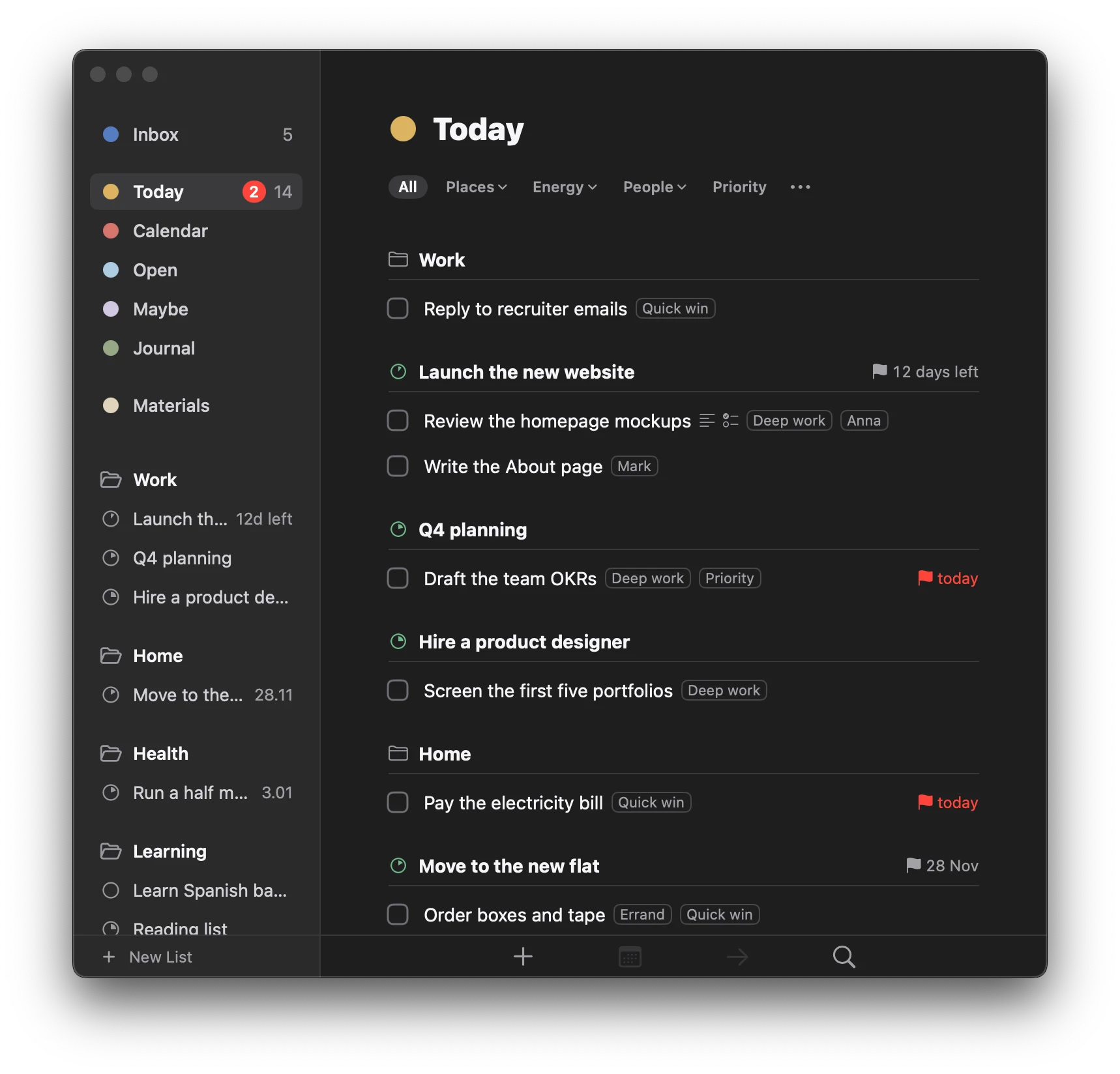
<p>I’ve spent the last 3 weeks building a to-do and notes system for myself. It’s called Saglyth: systems and goals let you thrive. It is a mix of my favourite apps: Bear, Things, and Obsidian.</p>

<p>I removed Obsidian and Things from my machines after 3 days of development. And since then I am mostly gold plating the app with animations, design, and other tweaks.</p>

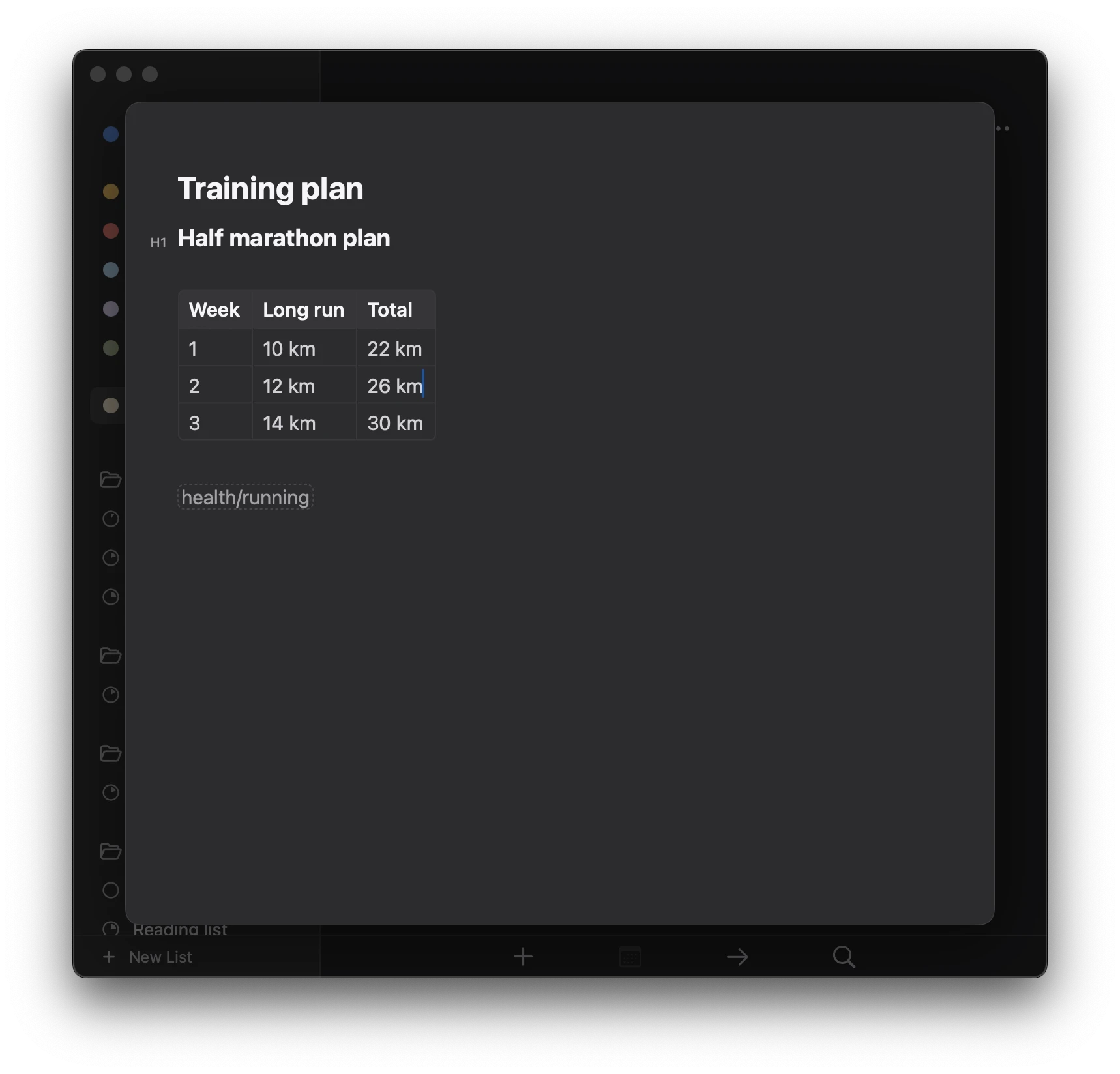
<p>It has Markdown, wiki links, locally stored files, Mermaid rendering, a fast interface, and many other features. It even works reasonably well with Claude. I manage Saglyth’s backlog using Claude in Saglyth.</p>

<p>Here are some screenshots.</p>

<p><img src="/assets/img/saglyth-today.webp" alt="Saglyth: the Today list" /></p>

<p><img src="/assets/img/saglyth-note.webp" alt="Saglyth: a note with a table" /></p>

<p>My process is not the best. Here’s how I work:</p>

<ol start="0">
  <li>Idea. Describe the idea to Claude via the app or via Claude desktop.</li>
  <li>Grooming. PM, BA, QA, and dev agents talk to each other to formulate spec. I re-read it, sometimes Claude asks questions. Here Claude also assigns the task to proper model.</li>
  <li>Development and code review.</li>
  <li>Then, building and using.</li>
</ol>

<p>The process is not the best and must be enhanced. Being Claude subscriber, I don’t really think of token usage, I have limits instead. Below what Claude calculated as usage and API price of the app.</p>

<table>
  <thead>
    <tr>
      <th>Model</th>
      <th>Tokens</th>
      <th>≈ $ at API prices<sup id="fnref:prices" role="doc-noteref"><a href="#fn:prices" class="footnote" rel="footnote">1</a></sup></th>
    </tr>
  </thead>
  <tbody>
    <tr>
      <td>Opus 5.5</td>
      <td>5.40 B</td>
      <td>2,200–2,600</td>
    </tr>
    <tr>
      <td>Sonnet 5.5</td>
      <td>515 M</td>
      <td>180–210</td>
    </tr>
    <tr>
      <td>Fable 5.1</td>
      <td>66 M</td>
      <td>75–90</td>
    </tr>
    <tr>
      <td>Haiku 5.5</td>
      <td>36 M</td>
      <td>~1</td>
    </tr>
    <tr>
      <td>Total</td>
      <td>6.02 B</td>
      <td>≈ 2,400–2,900</td>
    </tr>
  </tbody>
</table>

<p>What was the most emotional is not only how fast Claude is but how effective. I had a bug (the app was damn slow when I imported all my notes made since 2019) and Claude fixed it. A team of people would take weeks to do it.</p>

<p>So, to answer the question: building an app is super easy now. Period.</p>

<p>Now you can use an AI bro and solve all your problems (and probably your friends’). Go, legend!</p>

<div class="footnotes" role="doc-endnotes">
  <ol>
    <li id="fn:prices" role="doc-endnote">
      <p>All prices are calculated by Claude and may be wrong. <a href="#fnref:prices" class="reversefootnote" role="doc-backlink">&#8617;</a></p>
    </li>
  </ol>
</div>]]></content><author><name>Aliaksei Khavanski</name></author><category term="AI" /><summary type="html"><![CDATA[I am not a developer by any means. As a PM, I don’t even write SQL queries: Claude does it for me. The last time I wrote a script was about 3 years ago. I wanted an easy way to manage mic settings from the macOS menu bar (and I succeeded).]]></summary></entry><entry xml:lang="en"><title type="html">How to find product hypotheses</title><link href="https://akh.cx/2026-10-16-how-to-find-hypotheses.html" rel="alternate" type="text/html" title="How to find product hypotheses" /><published>2026-10-16T00:00:00+00:00</published><updated>2026-10-16T00:00:00+00:00</updated><id>https://akh.cx/how-to-find-hypotheses</id><content type="html" xml:base="https://akh.cx/2026-10-16-how-to-find-hypotheses.html"><![CDATA[<p>A great majority of product work is some hassle around hypotheses. You uncover them, build them, calculate if the new options work better than the control option. There are many ways to find them.</p>

<p>First, some philosophy. Each hypothesis gives some knowledge. The knowledge moves us to progress [1]. I think a new feature is a beginning of infinity. When you know it works, you can adjust it and new options till infinity.<sup id="fnref:romantic" role="doc-noteref"><a href="#fn:romantic" class="footnote" rel="footnote">1</a></sup></p>

<p>So my idea is that when you find an option in your product and see if it works better, you can develop new and a new thing over it. Now example.</p>

<p>You have an online shop which has a cart. When the cart is empty, you have a text there “Your cart is empty, go add stuff to it!”</p>

<p>From here you can change the text. “Sir/ma’am, your cart is empty. Please, add something there!” Or you can add link and “add stuff” is not a link to catalog. Or you can add a block with goods relevant to this user. There are other solutions here. As you can see, you can have several “beginnings of infinity” and each is rooted to some other beginning.</p>

<p>Why is it an infinity? I think, again, philosophically that working with hypotheses is a trial to find something perfecter than the previous option. Perfect means ideal and we know from philosophy that an ideal is unreachable in our unperfected world.</p>

<p><strong>So for me working with hypotheses is trying to find an option closer to perfection than the control option.</strong></p>

<h2 id="how-do-we-find-hypotheses">How do we find hypotheses?</h2>

<h3 id="philosophical-approach">Philosophical approach</h3>

<p>One answer is that you have to find hypotheses from going into the wild. In other words, you’re to use genchi genbutsu principle. It’s called CusDev in simple words. You go out, speak to people, and catch their pains, emotions, and so on. On the basis of it you can find some other hypotheses. It is called empiricism.</p>

<p>Deutsch — on the other hand — says that you have to come up with hypotheses yourself and then understand if ideas are wrong via testing. In case of products the testing is either CusDev or A/B testing.</p>

<h3 id="steal-from-peers">Steal from peers</h3>

<p>You can also use your peers to look for ideas. There are at least 4 types<sup id="fnref:competitors" role="doc-noteref"><a href="#fn:competitors" class="footnote" rel="footnote">2</a></sup> of competitors and each can give you different ideas. Some may give you an idea you can immediately introduce to your product, some can give you a side business you can adapt. You can be a competitor of some type, while vice versa you’re not a competitor.</p>

<p>My current company started a product of Post service. We were a potential competitor to other post service peers, now we’re a direct one. We’re a retail company, but your competitors are not only retailers. It may be a marketplace, a classified, or a company that has same service. Logistics is one of these. I will go back to this example later in this text.</p>

<p>So stealing a hypothesis may be a source of hypotheses for your company or product. What else?</p>

<h3 id="make-by-products-work">Make by-products work</h3>

<p>Let’s go back to retailer with logistics department that starts post service. Fried and DHH talked about it [2]:</p>

<blockquote>
  <p>When you make something, you always make something else. You can’t make just one thing. Everything has a by-product. Observant and creative business minds spot these by-products and see opportunities.</p>
</blockquote>

<p>From this logic logistics is a by-product of a retail company that can be packed into a product. Other examples? AWS and FBA<sup id="fnref:fba" role="doc-noteref"><a href="#fn:fba" class="footnote" rel="footnote">3</a></sup> are by-products of a huge company that has huge data centers and capacity in their delivery stations. This post is by-product of me overthinking simple concepts (<em>ha!</em>).</p>

<h3 id="use-problem-solving-frameworks">Use problem solving frameworks</h3>

<p>You can find ideas using various frameworks. A simple option is using ISRU that limits your field to what you have around you. This approach was discussed well in movies about NASA<sup id="fnref:nasa" role="doc-noteref"><a href="#fn:nasa" class="footnote" rel="footnote">4</a></sup> or in book “Inside the Box: A Proven System of Creativity for Breakthrough Results” by Drew Boyd and Jacob Goldenberg [3].</p>

<p>Let me introduce you quickly to other ideas from SIT that stands for Systematic Inventive Thinking.</p>

<p><strong>Subtraction</strong>. In e-comm example of subtraction are one-click checkout and guest checkout. The first gets rid of all the steps and gives a buyer immediate value: an order created in preferred way without any action from a user. The second gets sign up out of the way: you can buy and forget, why to bother with registration if it is once in a lifetime interaction for you?</p>

<p><strong>Multiplication</strong> is the evil twin of Subtraction. It allows you to multiply something to give value. Example is adding more ways to pay: by card, by cash, after delivery, using a BNPL service. You take one process (payment) and multiply ways to complete it so that more potential customers could use it. One more is showing mini-cart when a user hovers the main go-to-cart button. A user has basically same value in two ways if they have a mini cart.</p>

<p><strong>Division</strong> is best known by the usage of microservices or lazy load. More product-ish example would be partial delivery, BNPL, or checkout divided into parts.<sup id="fnref:ikea" role="doc-noteref"><a href="#fn:ikea" class="footnote" rel="footnote">5</a></sup> Each of them divide one task into smaller ones: you pay many times smaller amount; you receive a part of your order, but you get value faster.</p>

<p><strong>Task Unification</strong> also worked in e-commerce (or IT in general). When you tap search field you can often see the whole catalog. Here it is: one place unified two user actions.</p>

<p>The last from SIT is <strong>Attribute Dependency</strong>. It talks about merging several jobs<sup id="fnref:jtbd" role="doc-noteref"><a href="#fn:jtbd" class="footnote" rel="footnote">6</a></sup> into one. Before being bombed Russian marketplaces OZON and Wildberries were giving a place where you can pay and check the product. This same approach has <a href="https://eobuwie.com.pl/">E-obuwie</a>, a Polish biggest footwear online store: they have a store which is a place to test, select, store, and buy shoes.</p>

<h3 id="flow-analysis">Flow analysis</h3>

<p>You use <a href="https://www.certificate.tips/blog/business-analysis-diagrams-case-study">visualisation</a> techniques to draw flows in your products. From such analysis you can find places where a user could get stuck without further evident actions. E.g. in empty cart without any informational blocks. You can take as a rule that your user should never reach a dead end.</p>

<p>Such approach can be applied to business processes and technical systems. You can find steps or integrations that <em>may</em> not be needed.</p>

<hr />

<p>Instead of the finish: remember, that there are many (at least four) ways to find new ideas. Ideas and ways to enhance something will never end.<sup id="fnref:good" role="doc-noteref"><a href="#fn:good" class="footnote" rel="footnote">7</a></sup> When you have one, it is important to take action on it. Without an action, a brilliant idea dies.</p>

<h2 id="sources">Sources</h2>

<ol>
  <li>“The Beginning of Infinity”, — David Deutsch.</li>
  <li>“Rework”, — Jason Fried, David Heinemeier Hansson.</li>
  <li>“Inside the Box: A Proven System of Creativity for Breakthrough Results”, — Drew Boyd, Jacob Goldenberg.</li>
</ol>
<div class="footnotes" role="doc-endnotes">
  <ol>
    <li id="fn:romantic" role="doc-endnote">
      <p>Later in the text I will present my view of Deutsch’s idea. It is probably romantic and it’s not scientific. <a href="#fnref:romantic" class="reversefootnote" role="doc-backlink">&#8617;</a></p>
    </li>
    <li id="fn:competitors" role="doc-endnote">
      <p>Direct, indirect, substitute, and potential. <a href="#fnref:competitors" class="reversefootnote" role="doc-backlink">&#8617;</a></p>
    </li>
    <li id="fn:fba" role="doc-endnote">
      <p>Fulfillment by Amazon. <a href="#fnref:fba" class="reversefootnote" role="doc-backlink">&#8617;</a></p>
    </li>
    <li id="fn:nasa" role="doc-endnote">
      <p>I have watched none, it’s a hypothesis :) The term <a href="https://en.wikipedia.org/wiki/In_situ_resource_utilization">ISRU</a> comes from NASA.<br /><br />ISRU stands for In-Situ Resource Utilization. <a href="#fnref:nasa" class="reversefootnote" role="doc-backlink">&#8617;</a></p>
    </li>
    <li id="fn:ikea" role="doc-endnote">
      <p>AFAIK, e-comms tend to go into one-step checkout. I think this <em>may</em> be wrong, look at the IKEA principle for example. This idea assumes that a customer would love a product more if they set it up themselves. It also moves some costs from IKEA to customers, but 🤫 <a href="#fnref:ikea" class="reversefootnote" role="doc-backlink">&#8617;</a></p>
    </li>
    <li id="fn:jtbd" role="doc-endnote">
      <p>I mean JTBD here. <a href="#fnref:jtbd" class="reversefootnote" role="doc-backlink">&#8617;</a></p>
    </li>
    <li id="fn:good" role="doc-endnote">
      <p>Good news for product teams. <a href="#fnref:good" class="reversefootnote" role="doc-backlink">&#8617;</a></p>
    </li>
  </ol>
</div>]]></content><author><name>Aliaksei Khavanski</name></author><category term="Product" /><summary type="html"><![CDATA[A great majority of product work is some hassle around hypotheses. You uncover them, build them, calculate if the new options work better than the control option. There are many ways to find them.]]></summary></entry><entry xml:lang="en"><title type="html">AI made outcome harder, but increased output</title><link href="https://akh.cx/2026-10-12-ai-more-output-less-outcome.html" rel="alternate" type="text/html" title="AI made outcome harder, but increased output" /><published>2026-10-12T00:00:00+00:00</published><updated>2026-10-12T00:00:00+00:00</updated><id>https://akh.cx/ai-more-output-less-outcome</id><content type="html" xml:base="https://akh.cx/2026-10-12-ai-more-output-less-outcome.html"><![CDATA[<p>AI has increased amount of communication, in other words output, but not the outcome.<sup id="fnref:jevons" role="doc-noteref"><a href="#fn:jevons" class="footnote" rel="footnote">1</a></sup> It has decreased amount of ideas overall, density of notions per communication unit,<sup id="fnref:symbols" role="doc-noteref"><a href="#fn:symbols" class="footnote" rel="footnote">2</a></sup> and increased cognitive load for each knowledge worker.</p>

<p>As always, there’s no silver bullet, however we can work with these issues even now.</p>

<h2 id="density-of-communication">Density of communication</h2>

<p>You probably don’t want to make AI’s text too dense. High density text can’t be easily understood. Try a philosophy book (e.g. Hegel:). If a text is too dense, there’s high chance you’ll lose ideas and connections between them.</p>

<p>At the same time, AI’s text may look too low on density<sup id="fnref:density" role="doc-noteref"><a href="#fn:density" class="footnote" rel="footnote">3</a></sup>: you lose the idea while trying to understand it. My solution to it is to use proper instructions and experimentation. More on that in the next sections.</p>

<h2 id="amount-of-new-ideas">Amount of new ideas</h2>

<p>Novelty of AI’s ideas is an answered question: AI does not produce new ideas yet. LLM works as a generator based on a huge amount of texts, so it finds something applicable in your context, but doesn’t create anything from scratch.</p>

<p>However, novelty is in the context. For one, an idea of Agile is a disruption of their whole identity, but for other folk same happens when they hear of USSR’s 5-year-plans. So AI can generate something new for your specific context.</p>

<p>You don’t expect AI to produce new market disruption for you, but use it as an extended mind — and chance to get valuable result gets higher.</p>

<h2 id="what-worked-for-me">What worked for me</h2>

<p>While struggling with all the volume of text coming from AI, I have created this approach for me.</p>

<ol>
  <li>
    <p>Visuals.</p>

    <p>An LLM is not limited to text and can generate other forms of information: diagrams, tables, clickable visualizations. Use it for your purpose instead of a text.</p>

    <p>I believe that information in form of a text (just words following each other) is not a cure. You may ask AI visualization instead of text so that all the output is visible at one sight. But I have already spoken about it <a href="/2026-10-06-are-acceptance-criteria-a-section-of-a-backlog-item.html">here</a> and <a href="https://www.certificate.tips/blog/business-analysis-diagrams-case-study">here</a>.</p>
  </li>
  <li>
    <p>Create a skill that writes actually readable text.</p>

    <p>As I have an understanding of what exact form of ACs I like (and find readable) or texts produced by myself (incl. this one) I can formulate what discourse characteristics I possess and teach LLM to re-write in the way that I find better looking.</p>
  </li>
</ol>

<hr />

<p>So use your AI buddy with the proper density in the text, don’t expect it to create a new business for you, and set up proper rules.</p>

<div class="footnotes" role="doc-endnotes">
  <ol>
    <li id="fn:jevons" role="doc-endnote">
      <p>There’s the Jevons paradox: when efficiency grows, usage grows with it. So you can see how easy it is to produce a text now. <a href="#fnref:jevons" class="reversefootnote" role="doc-backlink">&#8617;</a></p>
    </li>
    <li id="fn:symbols" role="doc-endnote">
      <p>Written text does not transmit the whole message. AI fills the gap with the amount of text, while people solve this issue with communication: memes and overall context, hearing, seeing, touching. We aren’t limited to readable symbols. <a href="#fnref:symbols" class="reversefootnote" role="doc-backlink">&#8617;</a></p>
    </li>
    <li id="fn:density" role="doc-endnote">
      <p>Density is not a characteristic that shows if a text is good or bad. You can see good texts with high density (e.g. <em>Finite and Infinite Games</em> by James P. Carse or Seneca’s <em>Letters</em>) and with low density (<em>The Goal</em> by Goldratt or <em>The 80/20 Principle</em> by Richard Koch). <a href="#fnref:density" class="reversefootnote" role="doc-backlink">&#8617;</a></p>
    </li>
  </ol>
</div>]]></content><author><name>Aliaksei Khavanski</name></author><category term="AI" /><category term="Communication" /><summary type="html"><![CDATA[AI has increased amount of communication, in other words output, but not the outcome.1 It has decreased amount of ideas overall, density of notions per communication unit,2 and increased cognitive load for each knowledge worker. There’s the Jevons paradox: when efficiency grows, usage grows with it. So you can see how easy it is to produce a text now. &#8617; Written text does not transmit the whole message. AI fills the gap with the amount of text, while people solve this issue with communication: memes and overall context, hearing, seeing, touching. We aren’t limited to readable symbols. &#8617;]]></summary></entry><entry xml:lang="en"><title type="html">Minimum Viable Product in the LLM era. How does AI change it?</title><link href="https://akh.cx/2026-10-12-minimum-viable-product-ai-era.html" rel="alternate" type="text/html" title="Minimum Viable Product in the LLM era. How does AI change it?" /><published>2026-10-12T00:00:00+00:00</published><updated>2026-10-12T00:00:00+00:00</updated><id>https://akh.cx/minimum-viable-product-ai-era</id><content type="html" xml:base="https://akh.cx/2026-10-12-minimum-viable-product-ai-era.html"><![CDATA[]]></content><author><name>Aliaksei Khavanski</name></author><category term="Product" /><category term="AI" /><summary type="html"><![CDATA[A quick summary of three MVPs I participated in as a Business Analyst.]]></summary></entry><entry xml:lang="en"><title type="html">Diagrams in practice for Business Analysts: Building a visual knowledge base</title><link href="https://akh.cx/2026-10-11-business-analysis-diagrams-case-study.html" rel="alternate" type="text/html" title="Diagrams in practice for Business Analysts: Building a visual knowledge base" /><published>2026-10-11T00:00:00+00:00</published><updated>2026-10-11T00:00:00+00:00</updated><id>https://akh.cx/business-analysis-diagrams-case-study</id><content type="html" xml:base="https://akh.cx/2026-10-11-business-analysis-diagrams-case-study.html"><![CDATA[]]></content><author><name>Aliaksei Khavanski</name></author><category term="Diagrams" /><category term="AI" /><summary type="html"><![CDATA[I've spent ±2 years in that team to build the system of knowledge I describe in the article. It took a year to write it. Thanks, @Claude.]]></summary></entry><entry xml:lang="en"><title type="html">Are Acceptance Criteria a section of a backlog item?</title><link href="https://akh.cx/2026-10-06-are-acceptance-criteria-a-section-of-a-backlog-item.html" rel="alternate" type="text/html" title="Are Acceptance Criteria a section of a backlog item?" /><published>2026-10-06T00:00:00+00:00</published><updated>2026-10-06T00:00:00+00:00</updated><id>https://akh.cx/are-acceptance-criteria-a-section-of-a-backlog-item</id><content type="html" xml:base="https://akh.cx/2026-10-06-are-acceptance-criteria-a-section-of-a-backlog-item.html"><![CDATA[<p>From project to project I see that acceptance criteria for a PBI<sup id="fnref:pbi" role="doc-noteref"><a href="#fn:pbi" class="footnote" rel="footnote">1</a></sup> are in 99% of cases just a section in the task description. Those who write requirements add sections like <a href="/2021-09-11-user-stories-guide-for-junior-ba-po-pm.html">User Story</a>, links to designs or diagrams.</p>

<p>I don’t agree, and hear me out.</p>

<p>My take is that a ticket is a Card from the <a href="/2021-09-11-user-stories-guide-for-junior-ba-po-pm.html#три-с-в-user-story">3C model</a>. So Conversation and Confirmation happen upon a ticket. While a physical card was limited (due to its physical nature), today’s card are not limited and must contain wider amount of context for a task. In other words, a card should contain ‘all necessary information to complete it’.<sup id="fnref:upd" role="doc-noteref"><a href="#fn:upd" class="footnote" rel="footnote">2</a></sup></p>

<div class="anatomy" aria-label="Two cards: the conventional one with context, a design link and ACs; mine with context and everything else among the ACs">
  <figure class="an-view">
    <figcaption class="an-view-title">Conventional View</figcaption>
    <div class="an-card">
      <div class="an-row"><b>Context</b> why, what problem, for whom</div>
      <div class="an-row">🔗 Design, screenshot or flow</div>
      <div class="an-row">☑ Acceptance criteria</div>
    </div>
  </figure>
  <figure class="an-view">
    <figcaption class="an-view-title">My View</figcaption>
    <div class="an-card">
      <div class="an-row"><b>Context</b> why, what problem, for whom</div>
      <div class="an-acs-box">
        <div class="an-acs-title">Acceptance criteria</div>
        <div class="an-scraps">
          <span class="an-scrap"><span>Design</span></span>
          <span class="an-scrap"><span>Knowledge base</span></span>
          <span class="an-scrap"><span>NFRs</span></span>
          <span class="an-scrap"><span>Scenarios</span></span>
          <span class="an-scrap"><span>Design system</span></span>
          <span class="an-scrap"><span>Screenshots</span></span>
        </div>
      </div>
    </div>
  </figure>
</div>

<p>For me the must is Context. A description in any wording of why a card exists, what problem it solves and for whom. The rest can actually live somewhere outside the card: in a knowledge base, in a design system.</p>

<p>Then, I’d add a link to a design, a screenshot, or a flow. And the ACs.</p>

<p>Are ACs the only ACs? If you do not mention in ACs “The result follows the design” — but add a link inside the card or in a specific field — does it mean that there’s no such requirement? I think, the fact that there’s a link somewhere means that there’s a requirement <strong>and an AC</strong>!</p>

<h2 id="why-do-i-think-so">Why do I think so?</h2>

<ol>
  <li>A developer creates new feature based on full context, not only several short ACs.</li>
  <li>A QA checks the whole card and its context against what is actually done, not the ACs part of the card.</li>
  <li>A visualisation may present the same info, but without text. We can use a variety of visualisation techniques to show a requirement, and any of them may be better than pure text: a clickable prototype, UML / BPMN, a screenshot with red-pen redlines showing what to do. If we limit ourselves to text, we ignore a very good way of communication.</li>
</ol>

<h2 id="examples">Examples</h2>

<div class="alt">
  <div class="alt-tabs" role="tablist" aria-label="Kind of a picture">
    <button type="button" role="tab" aria-selected="true" data-for="redlines">Redlines</button>
    <button type="button" role="tab" aria-selected="false" data-for="uml">UML activity</button>
    <button type="button" role="tab" aria-selected="false" data-for="proto">Prototype</button>
  </div>

  <div class="alt-panel" data-panel="redlines" role="tabpanel">
    <div class="alt-text">
      <div class="alt-cap">As text</div>
      <div class="alt-ac-title">Acceptance criteria</div>
      <p>The text next to checkbox is changed from “Remember this card” to “Save card for one-tap pay”</p>
    </div>
    <div class="alt-pic">
      <div class="alt-cap">As a picture</div>
      <div class="rl-screen">
        <div class="rl-head">Checkout</div>
        <div class="rl-field">•••• •••• •••• 4242</div>
        <div class="rl-check"><i></i><span class="rl-old">Remember this card<b class="rl-strike"></b></span><span class="rl-new">Save card for one-tap pay</span></div>
        <div class="rl-pay">Pay $24</div>
      </div>
    </div>
  </div>

  <div class="alt-panel" data-panel="uml" role="tabpanel" hidden="">
    <div class="alt-text">
      <div class="alt-cap">As text</div>
      <div class="alt-ac-title">Acceptance criteria</div>
      <div class="alt-scroll">
        <ol class="alt-long">
          <li>When a user opens checkout, the system checks if the user has a saved card.</li>
          <li>If the user has a saved card, the system shows it first among the payment methods.</li>
          <li>The saved card is selected by default.</li>
          <li>When the user taps “Pay”, the system charges the saved card without asking for card details.</li>
          <li>If the user has no saved card, the system shows the card form.</li>
          <li>The card form has the checkbox “Save card for one-tap pay”, unticked by default.</li>
          <li>When the user fills in the form and taps “Pay”, the system charges the card.</li>
          <li>If the checkbox is ticked and the payment succeeds, the system saves the card.</li>
          <li>If the payment fails, the system does not save the card and shows the error.</li>
          <li>After a successful payment the system shows the confirmation screen.</li>
        </ol>
      </div>
    </div>
    <div class="alt-pic">
      <div class="alt-cap">As a picture</div>
      <svg class="uml" viewBox="0 0 300 440" role="img" aria-label="UML activity diagram of paying with a saved card">
        <defs>
          <marker id="uml-arrow" viewBox="0 0 10 10" refX="9" refY="5" markerWidth="7" markerHeight="7" orient="auto-start-reverse">
            <path d="M 0 1 L 9 5 L 0 9" />
          </marker>
        </defs>
        <defs>
          <marker id="uml-arrow" viewBox="0 0 10 10" refX="9" refY="5" markerWidth="7" markerHeight="7" orient="auto-start-reverse">
            <path d="M 0 1 L 9 5 L 0 9" />
          </marker>
        </defs>
        <g class="uml-edges">
          <path d="M150 20 V35" /><path d="M150 61 V82" />
          <path d="M134 98 H75 V137" /><path d="M166 98 H225 V137" />
          <path d="M225 163 V187" /><path d="M75 163 V250 H134" /><path d="M225 213 V250 H166" />
          <path d="M150 266 V272" /><path d="M150 298 V314" />
          <path d="M166 330 H215" /><path d="M150 346 V365" />
          <path d="M150 391 V408" /><path d="M255 343 V420 H162" />
        </g>
        <g class="uml-nodes">
          <circle cx="150" cy="12" r="8" class="uml-solid" />
          <rect x="85" y="35" width="130" height="26" rx="13" /><text x="150" y="52">Open checkout</text>
          <path d="M150 82 L166 98 L150 114 L134 98 Z" /><text x="176" y="94" class="uml-guard">has a saved card?</text>
          <text x="98" y="92" class="uml-guard">[yes]</text><text x="190" y="112" class="uml-guard">[no]</text>
          <rect x="10" y="137" width="130" height="26" rx="13" /><text x="75" y="154">Show saved card first</text>
          <rect x="160" y="137" width="130" height="26" rx="13" /><text x="225" y="154">Fill in card form</text>
          <rect x="160" y="187" width="130" height="26" rx="13" /><text x="225" y="204">Tick “Save card”</text>
          <path d="M150 234 L166 250 L150 266 L134 250 Z" />
          <rect x="95" y="272" width="110" height="26" rx="13" /><text x="150" y="289">Tap “Pay”</text>
          <path d="M150 314 L166 330 L150 346 L134 330 Z" />
          <text x="172" y="326" class="uml-guard">[failed]</text><text x="156" y="360" class="uml-guard">[paid]</text>
          <rect x="215" y="317" width="80" height="26" rx="13" /><text x="255" y="334">Show error</text>
          <rect x="70" y="365" width="160" height="26" rx="13" /><text x="150" y="382">Save card if ticked</text>
          <circle cx="150" cy="420" r="11" class="uml-end" /><circle cx="150" cy="420" r="6" class="uml-solid" />
        </g>
      </svg>
    </div>
  </div>

  <div class="alt-panel" data-panel="proto" role="tabpanel" hidden="">
    <div class="alt-text">
      <div class="alt-cap">As text</div>
      <div class="alt-ac-title">Acceptance criteria</div>
      <div class="alt-scroll">
        <ol class="alt-long">
          <li>When a user opens checkout, the system checks if the user has a saved card.</li>
          <li>If the user has a saved card, the system shows it first among the payment methods.</li>
          <li>The saved card is selected by default.</li>
          <li>When the user taps “Pay”, the system charges the saved card without asking for card details.</li>
          <li>If the user has no saved card, the system shows the card form.</li>
          <li>The card form has the checkbox “Save card for one-tap pay”, unticked by default.</li>
          <li>When the user fills in the form and taps “Pay”, the system charges the card.</li>
          <li>If the checkbox is ticked and the payment succeeds, the system saves the card.</li>
          <li>If the payment fails, the system does not save the card and shows the error.</li>
          <li>After a successful payment the system shows the confirmation screen.</li>
        </ol>
      </div>
    </div>
    <div class="alt-pic">
      <div class="alt-cap">As a picture: click around</div>
      <div class="proto" data-screen="form">
        <div class="pr-screen pr-form">
          <div class="pr-head">Checkout <span>$24</span></div>
          <div class="pr-field">Card number<b>4242 4242 4242 4242</b></div>
          <label class="pr-check"><input type="checkbox" /> Save card for one-tap pay</label>
          <button type="button" class="pr-btn" data-go="paid">Pay $24</button>
        </div>
        <div class="pr-screen pr-saved">
          <div class="pr-head">Checkout <span>$24</span></div>
          <div class="pr-card">Visa •••• 4242 <em>saved</em></div>
          <div class="pr-other">+ Another card</div>
          <button type="button" class="pr-btn" data-go="paid">Pay $24 in one tap</button>
        </div>
        <div class="pr-screen pr-paid">
          <div class="pr-done">✓</div>
          <div class="pr-thanks">Paid $24</div>
          <div class="pr-note"></div>
          <button type="button" class="pr-btn pr-again" data-go="again">Order again</button>
        </div>
      </div>
    </div>
  </div>
</div>

<h2 id="risks">Risks</h2>

<ol>
  <li><strong>Changes.</strong> Your links to sources should point to a specific version. You can do it both in Figma and in Confluence.</li>
  <li><strong>Inertia.</strong> For decades people have thought that an AC is a short text describing a feature, while in fact it is something we use for judgement: accept or not.</li>
</ol>

<hr />

<blockquote class="callout">
  <p>An AC is anything you’ll use to accept or reject the work.</p>
</blockquote>

<div class="footnotes" role="doc-endnotes">
  <ol>
    <li id="fn:pbi" role="doc-endnote">
      <p><em>Product Backlog Item.</em> It is something you add to your task tracker. <a href="#fnref:pbi" class="reversefootnote" role="doc-backlink">&#8617;</a></p>
    </li>
    <li id="fn:upd" role="doc-endnote">
      <p>Updated on 2026-10-08. <a href="#fnref:upd" class="reversefootnote" role="doc-backlink">&#8617;</a></p>
    </li>
  </ol>
</div>]]></content><author><name>Aliaksei Khavanski</name></author><category term="Backlog items" /><summary type="html"><![CDATA[From project to project I see that acceptance criteria for a PBI1 are in 99% of cases just a section in the task description. Those who write requirements add sections like User Story, links to designs or diagrams. Product Backlog Item. It is something you add to your task tracker. &#8617;]]></summary></entry><entry xml:lang="en"><title type="html">What is left for a human?</title><link href="https://akh.cx/2026-10-01-what-is-left-for-a-human.html" rel="alternate" type="text/html" title="What is left for a human?" /><published>2026-10-01T00:00:00+00:00</published><updated>2026-10-01T00:00:00+00:00</updated><id>https://akh.cx/what-is-left-for-a-human</id><content type="html" xml:base="https://akh.cx/2026-10-01-what-is-left-for-a-human.html"><![CDATA[<p>There’s a panic: what’ll be left for a human in the LLM-ish world? I assume it is an existential question for some (me!), and those who feel threatened are neither the first nor the last.</p>

<p>Indeed, an agent can do a lot of what previously was mainly ‘handmade’: code, writing, proposing solutions, search, even solving our homework.</p>

<p>At my current job, we’ve automated a lot of work using just Claude’s skills capability. The skill goes to Jira or RAG to gather context, understand the as-is state, formulate a solution. For hypotheses we have built a skill that can create SQL and calculate metrics based on ClickHouse’s data.</p>

<p>And it may seem that nothing’s left for us humans!</p>

<p>But I can’t agree.</p>

<p>I have spoken about it with several people and here’s the list of tasks that may still be left for us.</p>

<ol>
  <li>Logic and reasoning
    <ul>
      <li>Logic and reasoning is already done in AI. It can not only use proper formal logic approach, but also — with appropriate instructions — can use problem solving frameworks.</li>
      <li>Of course there are nuances to how it is solved. LLM can hallucinate or be based on wrong data (so that output is not logical).</li>
    </ul>
  </li>
  <li>Using problem solving frameworks<sup id="fnref:frameworks" role="doc-noteref"><a href="#fn:frameworks" class="footnote" rel="footnote">1</a></sup>
    <ul>
      <li>For example, an LLM can use Theory of Inventive Problem Solving or Systematic Inventive Thinking. E.g. an example of such skills: <a href="https://github.com/tjboudreaux/cc-thinking-skills">https://github.com/tjboudreaux/cc-thinking-skills</a>.</li>
    </ul>
  </li>
  <li>Communication and selling
    <ul>
      <li>Communication and selling is partially solved. AI can call a cold lead, rewrite your landing, you can even create a machine that would post to socials for you. It can use Cialdini’s persuasion framework.</li>
      <li>But communication is not a text-only activity. While AI can recreate some prosodic and textual characteristics (like tone, tempo, stress, specific word selection) it can’t use gestures, smiles, or other ‘physical’ ways to communicate yet.</li>
    </ul>
  </li>
</ol>

<p>So we can see, each task is solvable and even if it is not solved, it may be solved in the future. Let’s look at it through a different lens: what roles will stay with humans?</p>

<p>I think <strong>agency</strong><sup id="fnref:agency" role="doc-noteref"><a href="#fn:agency" class="footnote" rel="footnote">2</a></sup> will stay with humans, while acting can be delegated to an AI system. An agent (ha!) can act, but a human will be the source of action, of finding what can be done, adjusted, redone in a better way, or even invented.</p>

<p>Right now, many of us confuse agency with action. For example, I heard colleagues say “Claude did it, not me”, which is not true, if you have this principle in mind, since Claude did it only because you asked.<sup id="fnref:arendt" role="doc-noteref"><a href="#fn:arendt" class="footnote" rel="footnote">3</a></sup></p>

<p>But if you really think that Claude did it, then time’s against you.</p>

<div class="footnotes" role="doc-endnotes">
  <ol>
    <li id="fn:frameworks" role="doc-endnote">
      <p>Was: <del>Creative Problem Solving</del>. I mean using problem solving frameworks here (TRIZ, SIT, etc.). However, I assume creativity <em>may</em> be solved by AI. <a href="#fnref:frameworks" class="reversefootnote" role="doc-backlink">&#8617;</a></p>
    </li>
    <li id="fn:agency" role="doc-endnote">
      <p>Ability to act according to free will; to be a source of action. Some religions say (<a href="https://bible.by/nasb/1/2/#5">Genesis 2:5</a>) that a human is created to make the world better. I think agency allows to see how the world can be improved. Similar to Logos. <a href="#fnref:agency" class="reversefootnote" role="doc-backlink">&#8617;</a></p>
    </li>
    <li id="fn:arendt" role="doc-endnote">
      <p>This same notion was discussed decades ago in Hannah Arendt’s <a href="https://en.wikipedia.org/wiki/Eichmann_in_Jerusalem">Eichmann in Jerusalem</a>: AI will find a way to complete a task without asking why, but the result is yours. <a href="#fnref:arendt" class="reversefootnote" role="doc-backlink">&#8617;</a></p>
    </li>
  </ol>
</div>]]></content><author><name>Aliaksei Khavanski</name></author><category term="AI" /><summary type="html"><![CDATA[There’s a panic: what’ll be left for a human in the LLM-ish world? I assume it is an existential question for some (me!), and those who feel threatened are neither the first nor the last.]]></summary></entry><entry xml:lang="en"><title type="html">Definition of Ready used by my team on a “Big Three” firm’s projects</title><link href="https://akh.cx/2023-11-08-definition-of-ready.html" rel="alternate" type="text/html" title="Definition of Ready used by my team on a “Big Three” firm’s projects" /><published>2023-11-08T00:00:00+00:00</published><updated>2023-11-08T00:00:00+00:00</updated><id>https://akh.cx/definition-of-ready</id><content type="html" xml:base="https://akh.cx/2023-11-08-definition-of-ready.html"><![CDATA[<p>I was working on their projects for a long time and have started when there were no requirements at all captured in internal system: not in team’s Jira, not in team’s Confluence, not in other sources were team members could access it. But before we cure this problem, let’s dive into the basics.</p>

<h2 id="what-is-definition-of-ready-dor">What is Definition of Ready (DoR)?</h2>

<p>DoR is a document that is accepted by the team as a template for the next requirements. If a team has accepted some DoR, then all product backlog items are to follow it and contain each part of the document in it.</p>

<h3 id="why-should-a-team-accept-dor">Why should a team accept DoR?</h3>

<p>Using DoR would solve many problems that your team would face.</p>

<ul>
  <li><strong>Requirements are not estimated or prioritized</strong>. When a PBI<sup id="fnref:pbi" role="doc-noteref"><a href="#fn:pbi" class="footnote" rel="footnote">1</a></sup> is ready, it must have specific place on the backlog and contain estimation so that it can be planned.</li>
  <li><strong>The team does not understand requirements</strong>. Having a PBI is not only about having a set of rules for writing requirements. A ‘ready’ PBI is a one that is discussed with the team, so that you’re sure that relevant team members understand value and ‘to do’s of a PBI. The same thing will also help <strong>if team finds new cases when a feature is in progress</strong>.</li>
</ul>

<h3 id="definition-of-ready-vs-definition-of-done">Definition of Ready vs Definition of Done<sup id="fnref:dor-dod" role="doc-noteref"><a href="#fn:dor-dod" class="footnote" rel="footnote">2</a></sup></h3>

<p>There is another document whose name can confuse an aspiring BA: definition of done. While definition of ready is a document that is to be followed by those who create PBIs, definition of done is for those who <strong>do</strong> the PBIs.</p>

<h2 id="our-definition-of-ready">Our Definition of Ready</h2>

<p>Any backlog item on our product could be divided into 2 categories: new features or functions; adjustments to math of the analyses.</p>

<h3 id="for-new-functions">For new functions</h3>

<ul>
  <li>
    <p>Description of the value / context. It could be a <em>free text</em>, that would shortly describe the value behind the backlog item, or a <em>user story statement</em>, or a <em>job story</em>, or other similar thing.</p>

    <p>In this section of a PBI’s description an author has to answer <strong>why</strong> the function should be added, what need it addresses. The rest of the DoR answers <strong>what</strong> and <strong>how</strong>.</p>
  </li>
  <li>
    <p>Short description of the things this feature is to be capable of in order to be considered valuable. Here you answer the question “What should be done so that this item can be delivered?”</p>

    <p>To answer this question a framework called <em>acceptance criteria</em> (“A user can turn feature on”, “A user can open menu”, etc.) could be used.</p>
  </li>
  <li>
    <p>Then, describe <strong>scenarios</strong> that would show how a feature will be used. Requirements author can use a wide variety of frameworks here:</p>

    <ol>
      <li>you can use AC from the previous list item,</li>
      <li>you can use Gherk scenarios to cover each scenario,</li>
      <li>you can use any diagram to show the scenario instead of writing the whole long thing.</li>
    </ol>
  </li>
  <li>
    <p>After that, it is a good move to add some more <strong>details</strong>. For example, you can add a mock up (non-detailed image of the new feature) or just take a screenshot of an existing functionality and show what has to be changed using arrows and texts.</p>
  </li>
</ul>

<h3 id="specific-example">Specific example</h3>

<ul>
  <li><strong>User Story Statement</strong>: As a user I want to download analyses results in ThinkCell format so that I can create client PPTs faster.</li>
  <li><strong>Context</strong>: Our users use ThinkCell to create diagrams and chart inside client PPTs. Our export format allows them to get the results of analyses, but requires a lot of rework of an Excel to make a fine chart.</li>
  <li><strong>Acceptance criteria</strong>: (<em>Note: this is also a Definition of Done here!</em>)
    <ol>
      <li>A user can download an Excel file with analysis results AND the output Excel file contains a tab with data aligned to ThinkCell requirements.</li>
      <li>Rows and columns in ThinkCell tab correspond to specific Excel format.</li>
      <li>Feature can be turned on / off using config of an analyses AND is turned on by default.</li>
    </ol>
  </li>
  <li><strong>Other information:</strong>
    <ol>
      <li>A table that maps ThinkCell chart type vs analysis in our system.</li>
      <li>Description of how rows and columns must be accomodated in an output Excel in order to work in ThinkCell.</li>
    </ol>
  </li>
</ul>

<h3 id="for-new-analyses">For new analyses</h3>

<ul>
  <li><strong>Context</strong> in which analyses is working. Usually it is partially known as each data pipeline serves specific need (one would work with pricing, other with marketing or industry data overall). But even here there are things to clarify: <em>why the existing version is to be changed? on what stage an analyst would use this analysis?</em></li>
  <li>Then we go for <strong>As is</strong> where we describe how a problem is solved now. How the feature works. When you write it, you can be free here. Sometimes it would be useful to add some screenshots, in other cases description of cases would work. The only rule here is that <em>your team should understand how to read and understand the text.</em></li>
  <li>When current state is done, you dive into future state. I assume the same rules will apply here.</li>
</ul>

<h3 id="some-practical-rules-for-dors">Some practical rules for DoRs</h3>

<ol>
  <li>
    <p><strong>Use same formats</strong>. On your project you should use same set of ‘fields’ for requirements descriptions. Your team will create a habit of reading and understanding one format, one approach. When they have same format, they will just read and understand the text faster (<em>Do you remember when reading BABOK and you understood the format of chapters?</em>)</p>
  </li>
  <li>
    <p><strong>Don’t use the set of ‘fields’ as a must</strong>. Don’t take all the fields of your DoR as a must. Too much information could be waste. For example, for some PBIs you probably don’t need detailed scenarios, UMLs or other diagrams, or even too many specific details like colours, texts.</p>

    <p>Your PBI <em>may</em> be ready when you have agreement with your team and decision makers on what and how should be done. If you have fixed it as a text in a ticket ot other description, then following a format may be a waste, invaluable work.</p>
  </li>
  <li>
    <p><strong>Follow 3 C framework: Card, Conversation, Confirmation</strong>. While a tool where your requirement is a card, you have to drive conversation and confirmation.</p>

    <ul>
      <li>For <strong>card</strong> you can use the system where PBI is described. It may be a page in Confluence or a Jira ticket. No need for a physical card :)</li>
      <li>For <strong>conversation</strong> you can use comments section to discuss features. Confluence allows to create a comment for the whole page (<em>you can use it for approving your requirements!</em>) or for specific parts, lines of your text. Also, don’t forget that we can use ‘three amigos’ technique: call your colleagues and discuss the requirements.</li>
      <li>For <strong>confirmation</strong> you can use your decision maker’s virtual signature. Just ask them you add “approve” comment when description is approved.</li>
    </ul>
  </li>
  <li>
    <p><strong>Go with simple frameworks</strong> as no one wants to understand how to use / read your texts before understanding the contents of it. For example, sometimes it is better to use flowcharts instead of complex UMLs as not all of your teammates know how to read them, but anyone can follow simple flowchart. Use simpler lexicon and those terms that are already used in other PBIs or documents.</p>
  </li>
</ol>

<p><em>Originally published on <a href="https://akhavanski.medium.com/definition-of-ready-used-by-my-team-on-a-big-three-firms-projects-8c9a3699a372">Medium</a> on November 8, 2023.</em></p>

<div class="footnotes" role="doc-endnotes">
  <ol>
    <li id="fn:pbi" role="doc-endnote">
      <p><em>Product Backlog Item.</em> It is something you add to your task tracker. <a href="#fnref:pbi" class="reversefootnote" role="doc-backlink">&#8617;</a></p>
    </li>
    <li id="fn:dor-dod" role="doc-endnote">
      <p>Years go, but the issue is still the same: how to distinguish these two? <img src="/assets/img/dor-vs-dod.png" alt="" /> <a href="#fnref:dor-dod" class="reversefootnote" role="doc-backlink">&#8617;</a></p>
    </li>
  </ol>
</div>]]></content><author><name>Aliaksei Khavanski</name></author><category term="Backlog items" /><summary type="html"><![CDATA[I was working on their projects for a long time and have started when there were no requirements at all captured in internal system: not in team’s Jira, not in team’s Confluence, not in other sources were team members could access it. But before we cure this problem, let’s dive into the basics.]]></summary></entry><entry xml:lang="en"><title type="html">Telling a good Job Story. User Story alternative to uncover user’s voice</title><link href="https://akh.cx/2023-10-18-telling-a-good-job-story.html" rel="alternate" type="text/html" title="Telling a good Job Story. User Story alternative to uncover user’s voice" /><published>2023-10-18T00:00:00+00:00</published><updated>2023-10-18T00:00:00+00:00</updated><id>https://akh.cx/telling-a-good-job-story</id><content type="html" xml:base="https://akh.cx/2023-10-18-telling-a-good-job-story.html"><![CDATA[<p>User Stories are considered a standard for the requirements catching. I see them mentioned in every open job. You have to tell them if you want to be a PM, PO, or a BA. But what if I tell you they’re not the only and they’re not the best to catch the value of a new feature?</p>

<p>The next text heavily cites Evan Zamesin, a Russian enterpreneur and JBTD researcher. I respect his approach to study and uncover new knowledge and thank Evan for showing me the Job Stories value and usage on his course.</p>

<h2 id="the-main-issue-of-a-user-story">The main issue of a User Story</h2>

<p><strong>User Stories</strong> exist in IT for a pretty long time (I have already mentioned, that they’re the standard now). I always thought they were first introduced in 2004 in the book “User Stories applied”, but Wikipedia says the come from 1997 [1]. User Stories are written in a specific an short form: “As %stakeholder%, I want %solution%, so that I %value%”. The problem, in my opinion, is that this format doesn’t catch a lot of context for the ‘story’ and that is why we add lots of other info to a Jira entity.</p>

<p>And this flaw is solved by the newer format (year 1999 according to Wikipedia [2]) called Job Stories.</p>

<h2 id="just-mentioning-other-ways-to-catch-the-customers-value">Just mentioning other ways to catch the customer’s value</h2>

<ul>
  <li><strong>Gherkin</strong> Scenarios allow us to describe usage scenarios in all details. They concentrate on solution, and forget need and value — but speaking sincerely Gherkin is not built for it [3].</li>
  <li><strong>Acceptance criteria</strong> say us what qualities should a feature contain in order to be good enough [4].</li>
  <li><strong>Use Cases</strong> show how a feature should work, who uses it, and the flows, ‘unhappy’ scenarios are included [4].</li>
</ul>

<h2 id="attempting-to-define-the-job">Attempting to define the Job</h2>

<p>Russian product manager and entrepreneur Evan Zamesin says, that a job is an aim created by our brain to satisfy a deep psychological need [5]. Zamesin mentions also, that a catching person’s psychological need is something only an experienced UX researcher could catch, as they lie deeply under many layers of a person’s life, trauma, and other experiences. Job at the same time are located not far from the ‘highest’ layer and can be easily caught by a researcher.</p>

<p>For me Zamesin’s definition doesn’t work from first and even second reading, so I tried to find some synonyms. And we can use Job meaning Task and Sub-Task. Look at this phrase by Van Neistat who is not an IT or product person: “<em>They start: looking for their keys, lacing up their shoes, opening Google Maps — all the hundreds of little tiny <strong>JOBS</strong> they have to do to get there on time</em>” [6]. He uses the term Job exactly in a sense of a task: this is what has to be done in order to complete a bigger task (job).</p>

<p>Job stories are written based on interviews’ results. Interviewee indicates all the parts of a statement during the interview. That is why in the next parts of the article I will use term ‘interviewee’ instead of ‘user’ which is more traditional and familiar to an aspiring researcher’s ear.</p>

<h2 id="recruiting-a-product-solution-and-creating-solutions-value">Recruiting a product (solution) and creating solution’s value</h2>

<p>Jobs to be done is based on one important idea that is worth mentioning [7]. People recruit product to complete jobs. If an existing solution doesn’t work well or has issues, people tend to open the job and start looking for better candidates. When found, they move to it. Why could someone move to another solution? Let’s take a look on some (<em>not all!</em>) mechanics you could use to create value of your product.</p>

<h3 id="1-kill-unnecessary-jobs-needed-to-get-the-job-done-5">1. Kill unnecessary jobs needed to get the job done [5]</h3>

<p>New solution’s value could consist in having less smaller jobs needed to accomplish the initial one. For example, when I send something using Polish InPost service I tend not to print the label: they allowed sending without adding the label. That eliminated a job (or the job was given back to the service) and makes less steps to complete the initial one. Saves time and nerves (and sometimes even money).</p>

<p>An example could be catering services, they have : When I want to eat healthy food AND I don’t want to spend time cooking (I don’t know how to prepare food, I don’t want to select what to cook), I want my dish to be delivered to me, so I can</p>

<h3 id="2-uncover-new-jobs-5">2. Uncover new jobs [5]</h3>

<p>Zamesin calls this type of Jobs ‘sleeping’ [5]. A customer, future user doesn’t know that these even exist and that they would need something for this need. This same notion is also mentioned by Drucker. He says: “<em>Markets are not created by God, nature, or economic forces but by businesspeople. … The want may have been unfelt by the potential customer; <strong>no one knew that he wanted a Xerox machine or a computer until these became available</strong>. There may have been no want at all until business action created it — by innovation, by credit, by advertising, or by salesmanship. In every case, it is business action that creates the customer</em>” [8].</p>

<p>There is no way to systematically uncover sleeping jobs. This combines a lot of factors like luck, entrepreneur talent, and just having good skills of observation. If you find a way to uncover these type of jobs, I could only congratulate you: you’re a millionaire now.</p>

<h3 id="3-get-rid-of-tax-jobs-5">3. Get rid of ‘tax’ jobs [5]</h3>

<p>Tax jobs are those that a person does saying ‘meh’ instead of ‘yeah’. When you get rid of it, more ‘yeah’ could appear, or at least less barriers are encountered in your product. If we get back to the AirPods, then Apple has removed wires: now you don’t have to unravel them before talking. They also added a better mic so that you don’t have to hold the mic right way to be heard.</p>

<h3 id="4-open-new-segments-for-the-same-jobs-5">4. Open new segments for the same jobs [5]</h3>

<p>When you already have your product, you can make segment pivot to completely change your user persona. But you can also enhance your persona vision by adding a new segment and incorporate their jobs into your product. Going to AirPods again. Apple has added new segment by adding Pro and Max products to their line. <em>Fun fact: IT people hire AirPods Max so that they look better on calls, not for any quality like reason (someone has made a research on it)</em>.</p>

<h3 id="5-add-new-jobs-to-your-product-5">5. Add new jobs to your product [5]</h3>

<p>Probably, the simplest one. When you already have a product that covers some set of jobs, you can (probably) make this product better by enhancing it with more jobs it covers for users.</p>

<h2 id="job-stories-a-framework-to-describe-jobs">Job Stories: a framework to describe jobs</h2>

<p>Job Story consists of three main parts: when, want, so [5]. Additionally, a good Job Story could contain details like solutions already in use and issues of these solutions.</p>

<p>Examples:</p>

<blockquote>
  <p><em>When an order is submitted, I want to see a warning message so I can avoid resubmitting the order.</em></p>

  <p><em>When I am looking for a new place to live AND I have a dog AND I live with my partner, I want to find a place to live that will close all my needs, so we can have a good level of life.</em></p>

  <p><em>When I don’t have enough money AND I see a new pair of shoes AND I am having an important meeting in real life I want to buy that pair So I feel confident about the meeting.</em></p>
</blockquote>

<h3 id="when">When</h3>

<p><strong>“When”</strong> is where we describe the context where the interviewee exists. This person is not a usr yet: our solution may not exist, but in their context they already have the pain and already do this job. In context we can place emotion (When I am sad…), economic or life state (<em>When I have no money on my account</em> OR <em>When I am looking for a new flat…</em>), or any other things describing context where the interviewee lives (<em>When we’re a family with three kids</em> OR <em>When my relationship with my boyfriend are being destroyed</em>). You can also combine the “contexts”: emotions + economic state + any other things. <strong>The only rule here is: the more information we have here the better</strong> [5].</p>

<h3 id="want">Want</h3>

<p><strong>“Want”</strong> part represents the understandable results which a person wants to get in the context specified previously. These are the exact state interviewee wants to achieve when they’re in the context specified previously. Unlike in User Stories, this part can but mustn’t concentrate on the solution. It is exactly about the need or a problem a person has and wants to ‘heal’.</p>

<h3 id="so">So</h3>

<p>This part shows why the want part is actually needed. It may unveil a higher-level job or need. Like ‘be happy’ or ‘feel good’. But in real life you will likely not see examples like these. They will be precise, but will still identify a higher-level job for you.</p>

<h2 id="when-i-finish-my-article">When I finish my article…</h2>

<blockquote>
  <p><strong><em>When</em></strong> <em>I finish my article AND I tend to do UX research job I</em> <strong><em>want</em></strong> <em>this article to be helpful to my readers, so I feel like I’ve done good job.</em></p>
</blockquote>

<p>Hope I’ve demonstrated the value teams could gain from using Job Stories for their product’s backlog. I also hope that more teams will use interviews as a cheap and fun method to gain data on their products. Thanks for reading.</p>

<h2 id="sources">Sources</h2>

<ol>
  <li>“User Story”, — Wikipedia. URL: <a href="https://en.wikipedia.org/wiki/User_story">https://en.wikipedia.org/wiki/User_story</a></li>
  <li>“Outcome-Driven Innovation”, — Wikipedia. URL: <a href="https://en.wikipedia.org/wiki/Outcome-Driven_Innovation">https://en.wikipedia.org/wiki/Outcome-Driven_Innovation</a></li>
  <li>“Agile Extention to BABOK Guide. 2nd edition”, — IIBA.</li>
  <li>“Business Analysis Body Of Knowledge. 3rd edition”, — IIBA.</li>
  <li>“How to make a product, a course”, — Evan Zamesin.</li>
  <li>“Your tardy friends suck. 7 Principles”, — Van Neistat. URL: <a href="https://www.youtube.com/watch?v=Hm4mr7jzSpQ">https://www.youtube.com/watch?v=Hm4mr7jzSpQ</a></li>
  <li>“Data-driven Product Management Simulator”, — Go Practice.</li>
  <li>“The Essential Drucker”, — Peter F. Drucker.</li>
</ol>

<p><em>Originally published on <a href="https://akhavanski.medium.com/telling-a-good-job-story-user-story-alternative-to-uncover-users-voice-f4d4592b1d10">Medium</a> on October 18, 2023.</em></p>]]></content><author><name>Aliaksei Khavanski</name></author><category term="Backlog items" /><summary type="html"><![CDATA[User Stories are considered a standard for the requirements catching. I see them mentioned in every open job. You have to tell them if you want to be a PM, PO, or a BA. But what if I tell you they’re not the only and they’re not the best to catch the value of a new feature?]]></summary></entry><entry xml:lang="en"><title type="html">Common mistakes of a Junior Business Analyst and an approach to fixing them</title><link href="https://akh.cx/2022-10-03-common-mistakes-of-a-junior-business-analyst.html" rel="alternate" type="text/html" title="Common mistakes of a Junior Business Analyst and an approach to fixing them" /><published>2022-10-03T00:00:00+00:00</published><updated>2022-10-03T00:00:00+00:00</updated><id>https://akh.cx/common-mistakes-of-a-junior-business-analyst</id><content type="html" xml:base="https://akh.cx/2022-10-03-common-mistakes-of-a-junior-business-analyst.html"><![CDATA[<p>If you’re starting your BA life, you can use this article as a list of practices to escape.</p>

<p>Being new to a sphere is hard. Especially in a sphere where you actually need help to do the first steps right. I’ve done my first steps in business analysis with no help from mentors and it resulted in a catastrophe. Let me give you a breve overview of possible junior BA mistakes and how could you overcome them.</p>

<h2 id="fear-of-asking-more-questions">Fear of asking more questions</h2>

<p>I had too much fear to ask questions. I thought I can ask a dumb question, but only a question not asked can be considered a dumb one. Actually, a BA has to ask all possible questions to all possible groups of stakeholders as only it can help to understand the problem from all sides.</p>

<p><strong>How to overcome it?</strong> People can think your question is stupid on many occasions. Some think a bad question is one that is too basic, not in time or communicated to the wrong person. To soften “dumbness” of a question you can explain the context and why of the question.<br />
Accept the fact that a question should be considered silly only when it’s not asked and don’t be shy. As a BA you are to explain a problem to developers and there is no way to do it without understanding it. And to understand you have to ask questions.</p>

<h2 id="not-enough-meetings-with-devs">Not enough meetings with devs</h2>

<p>For some reason, developers, in general, don’t like meetings. They think it’s a waste of their time. In this case, we didn’t even ask devs if they want to participate or not. In the end, the lack of communication resulted in the fact that all sides understand each other very bad.</p>

<p><strong>How to overcome it?</strong> You have to always engage your stakeholders in work on the project and in open communication. Developers are also a group of stakeholders, aren’t they?<br />
What you can do to engage them? Just ask them to have a brief call with you. Patiently explain the problem you’re facing, note the answers, ask more questions. As a BA you don’t need to be a tech guy, but you have to understand the technical part of the solution. To do it you can study coding (but is it a good solution?) or just ask your devs to tell you how and what is being done.<br />
Speaking about stakeholder engagement, there is no need to hide one stakeholder party from another, let them meet, let them understand each other, and later implement what would give the most value to the end customer. As a BA you can just schedule a call for all needed groups to get a common understanding.</p>

<h2 id="no-formal-follow-ups-with-the-client">No formal follow-ups with the client</h2>

<p>When you speak to someone and you gain consensus on something in the BA context, you have to fix it somewhere. Period. I didn’t understand this rule, so after speaking to a client I only adjusted the tickets or communicated the change to the developers.<br />
How could formal follow-ups help your project? If you have a project with a high amount of risks or your client is sending change requests as bugs, then you have to defend your team and company.</p>

<p><strong>How to overcome it?</strong> Just note all the decisions made during a meeting and send the list to the relevant stakeholders to inform them. It can be an email or a confluence page. This can be considered a document, so this will help you to defend your team in case the client does not agree on some aspects of the developed solution.</p>

<h2 id="a-bad-ba-approach-chosen">A bad BA approach chosen</h2>

<p>BABOK has good advice on how to choose an appropriate BA approach, but I ignored it. The project had high risks due to the type of client and client relations with the initiative dev team and the company as a whole. In this situation, I had to use a formal approach to reduce all these risks.</p>

<p><strong>How to overcome it?</strong> When planning and approaching you to have to ask questions about the type of client &amp; project, risks, and challenges in engaging stakeholders. Considering all these (and even more) factors you can choose the right BA approach and finish the project well.</p>

<h2 id="no-modeling-done">No modeling done</h2>

<p>The system was pretty complex and only one team member knew how this machine works. I had not only to become the second one but also to document it so that we could summon 3rd, 4th, and even more.</p>

<p><strong>How to overcome it?</strong> What’s the best way to document a complex system? To make a model (diagram) which will give a big overview easily and fast. No one actually wants to read long texts.<br />
Diagramming may require a big effort from a business analyst, but the result pays off when new people come or the experienced guys need to refresh their knowledge.</p>

<h2 id="no-knowledge-base-for-devs-and-qas">No knowledge base for devs and QAs</h2>

<p>Making the best requirements architecture for the context you operate in is essential to BA. I ignored this task completely. It caused not inability for easy onboarding of new team members, but also those who have already been onboarded had no place to check if a requirement exists, whether was it implemented or not, how it works, and how can a new requirement impact already implemented features.</p>

<p><strong>How to overcome it?</strong> If you have a complex system, then you won’t ever be able to remember all the functions in it. Be ready to develop the approach to document it and allocate it properly in your document storage. These documents should be accessible by the customer as well as by the team and give them the needed level of detail on functions implemented.</p>

<h2 id="conclusion">Conclusion</h2>

<p>We all make mistakes. Sometimes they’re big, sometimes they’re smaller, but we have to study from these mistakes and don’t repeat them. Iterate a personal performance review to find your weak points and become better and better each day.</p>

<p><em>Originally published on <a href="https://akhavanski.medium.com/as-a-junior-business-analyst-i-made-many-mistakes-during-my-1st-project-heres-a-way-to-fix-them-a4bf7ac0685f">Medium</a> on October 3, 2022.</em></p>]]></content><author><name>Aliaksei Khavanski</name></author><category term="Communication" /><summary type="html"><![CDATA[If you’re starting your BA life, you can use this article as a list of practices to escape.]]></summary></entry></feed>